
The Operational Bottleneck of Legacy Equipment in High-Density Warehousing
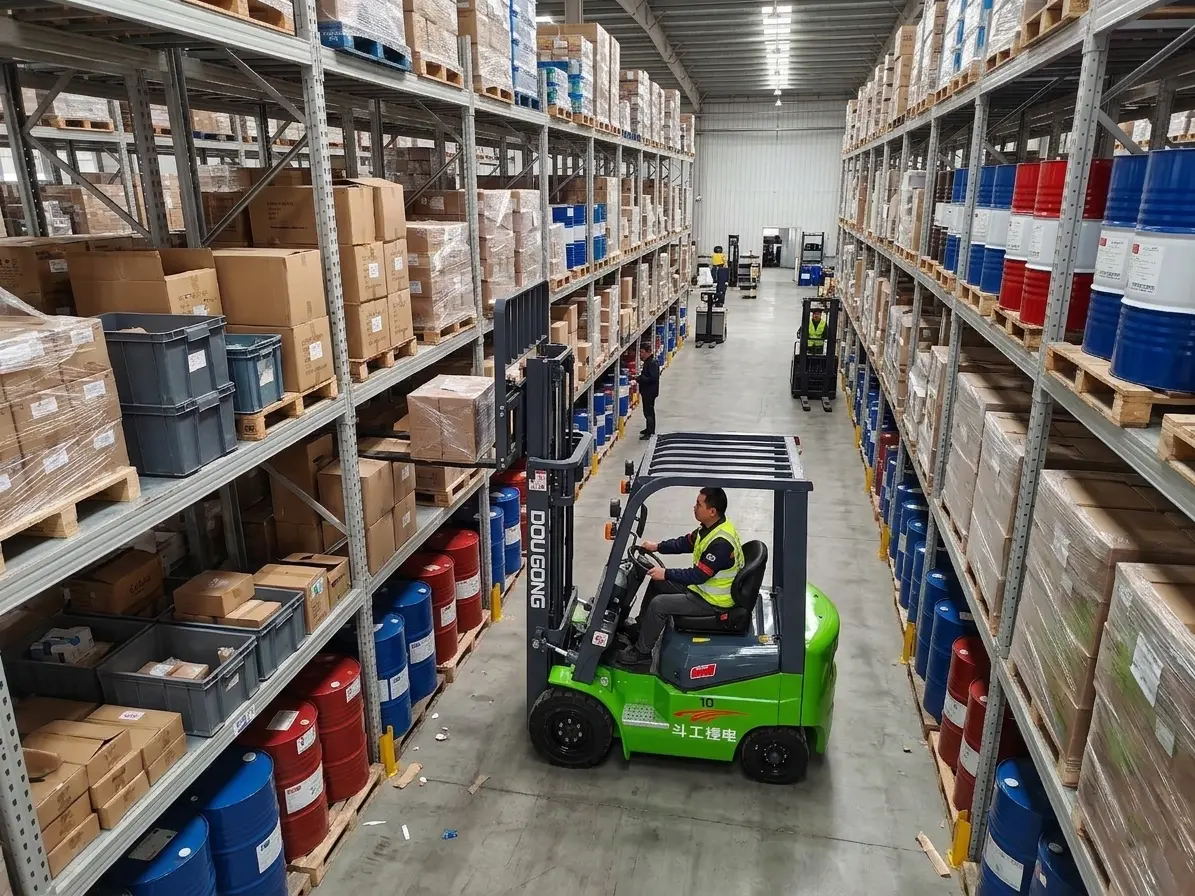
In the modern logistics landscape, space is a premium commodity, and time is an unyielding metric of profitability. As warehouse managers and factory owners strive to maximize their return on investment per square foot, the architectural trend has decisively shifted toward high-density storage configurations. This necessitates narrower aisles and taller racking systems. However, this evolution in storage strategy has exposed a critical vulnerability in many operational fleets: the inherent limitations of legacy material handling equipment. When operating in confined spaces, the deep-seated flaws of traditional internal combustion forklifts and entry-level electric models become painfully apparent.
These older or lower-tier machines are frequently characterized by cumbersome proportions, sluggish response times, and heavy steering mechanisms. When operators attempt to navigate tight corridors, the lack of precision inherently slows down the handling cycle. The consequences are multifaceted: increased risk of racking collisions, product damage, and a fundamental failure to meet high-intensity throughput targets. Furthermore, the sheer mechanical complexity and frequent maintenance requirements of these legacy systems lead to unpredictable downtime, disrupting carefully orchestrated logistics chains. As a senior technology product manager at a premier electric forklift manufacturer, I have observed firsthand how these inefficiencies erode warehouse profitability. The solution does not lie in simply building a smaller machine, but in fundamentally re-engineering the relationship between the operator, the equipment, and the operational environment.
Redefining Operator Interaction: Ergonomics as a Driver of Throughput
To truly optimize a high-intensity handling operation, we must look beyond the basic specifications of the machinery and focus on the human element. The operator is the central processor of any warehouse logistics system, and their physical well-being is directly correlated to the facility’s overall productivity. Heavy industrial operations have traditionally taken a severe toll on the human body, with repetitive strain and muscle fatigue accepted as unavoidable costs of doing business. The DOGON CPD series was engineered to dismantle this paradigm entirely.
At the core of the DOGON CPD’s user experience is the integration of a fully hydraulic power steering system paired with an advanced, ergonomic fingertip operating system. This configuration fundamentally transforms heavy industrial material handling, elevating it to deliver a delicate, highly responsive feel akin to driving a modern luxury vehicle. By meticulously redesigning the hydraulic pathways and optimizing the control interface, we have successfully reduced the required operating torque by a staggering 25% compared to traditional models in the same weight class.
This reduction is not merely a comfort feature; it is a critical operational advantage. In a fast-paced environment where an operator may execute hundreds of lifting, tilting, and turning maneuvers per shift, a 25% reduction in physical exertion translates directly into sustained mental acuity and physical stamina. The fingertip control system replaces heavy, clunky mechanical levers with micro-movement joysticks that respond instantly to the operator’s intent. This gives the driver a profound, precise sense of control—an intuitive understanding of exactly “where to hit” when aligning heavy loads with high-level racking.
By eliminating the need for forceful steering corrections and strenuous lever manipulation, the DOGON CPD significantly mitigates the risk of occupational injuries such as carpal tunnel syndrome, shoulder strain, and chronic back pain. When operators are free from the distraction of physical discomfort, their error rates plummet, their cycle times become remarkably consistent, and the overall safety culture of the warehouse is vastly improved. We are not just supplying high-quality electric forklift parts; we are delivering a comprehensive ergonomic solution that protects your workforce and accelerates your throughput.
The Space Economics of the Narrow Body Chassis: Maximizing Storage Density
The modern warehouse is a masterclass in spatial economics. Every millimeter of aisle width subtracted is a millimeter of potential storage capacity added to the bottom line. However, compressing aisle dimensions is only financially viable if your material handling fleet possesses the agility to operate within them efficiently. This is where the engineering philosophy behind the DOGON CPD truly distinguishes itself from the broader market.
Our engineering team recognized that a sprawling, bulky footprint is the enemy of dense storage. Therefore, we developed a unique “narrow body chassis” design coupled with a highly innovative, compact counterweight solution. By utilizing advanced materials and reconfiguring the internal architecture of the chassis—optimizing the placement of every component from the drive motors to the hydraulic pumps—we achieved an incredibly dense center of gravity without compromising stability or lifting capacity.
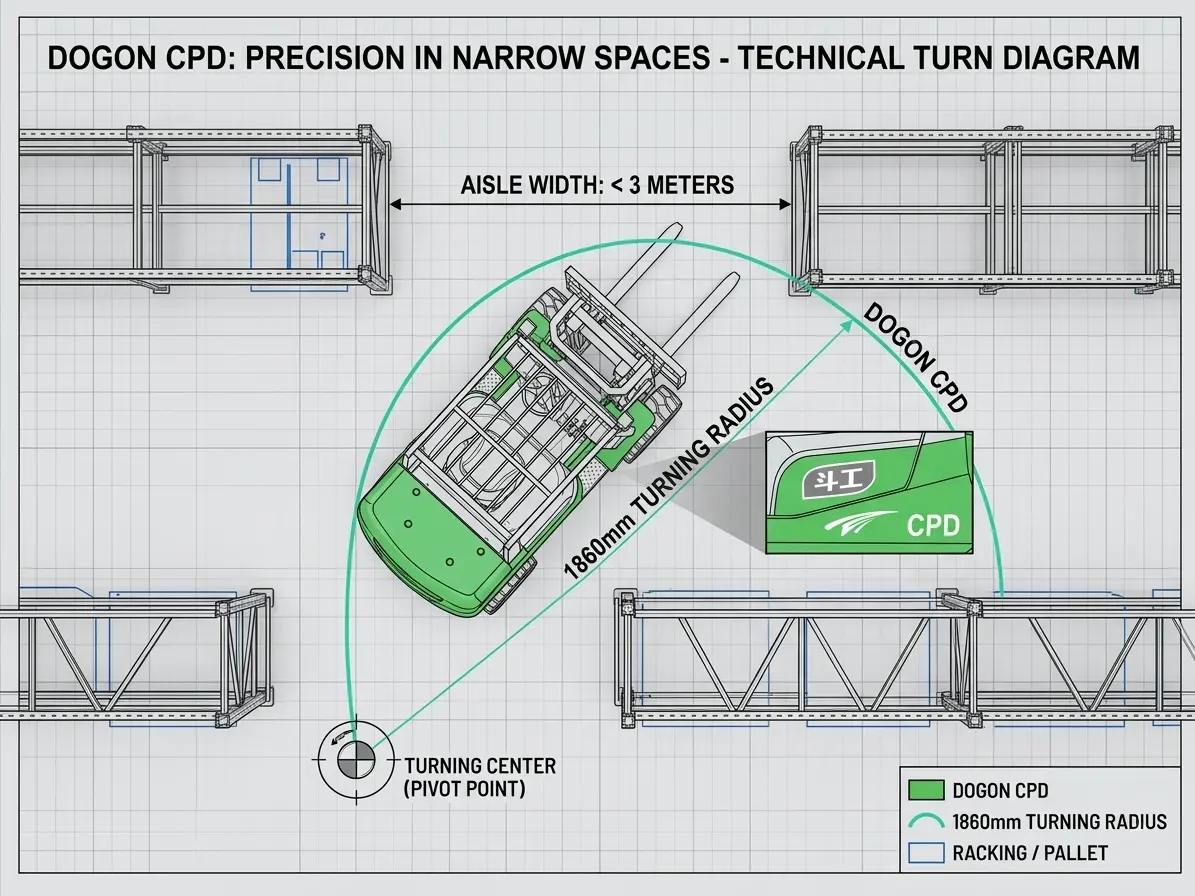
The immediate result of this engineering triumph is a highly nimble machine boasting an exceptionally tight turning radius of only 1860mm. This metric is not just a specification on a brochure; it is the key to unlocking the full potential of your warehouse layout. An 1860mm turning radius is critical for achieving smooth, rapid U-turns and right-angle stacking maneuvers in narrow shelf aisles that measure less than 3 meters in width.
Consider the operational reality: in an aisle less than 3 meters wide, a traditional forklift will require multiple, time-consuming repositioning adjustments—often referred to as a “three-point turn”—just to align a pallet with a rack. The DOGON CPD, by contrast, flows through these confined spaces seamlessly. The narrow body chassis allows the machine to hug the racking closely, providing the operator with superior visibility and the geometric freedom to pivot the load into position in a single, fluid motion. This capability to achieve precise steering and cargo stacking within extreme distances effectively transforms previously unusable or frustratingly tight zones into high-value storage real estate. Whether you are operating our flagship models or a nimble 1 ton electric forklift designed for lighter, specialized tasks, this commitment to spatial efficiency ensures that your facility can scale its inventory density without hitting an operational ceiling.
Eradicating Shift Disruptions: High-Energy-Density Power Systems
While agility and ergonomics address the speed of individual tasks, the true measure of a logistics operation’s profitability is its continuous uptime. In transnational logistics hubs and high-volume manufacturing facilities, multi-shift operations are the standard. The greatest threat to continuous workflow in these environments is equipment downtime, and historically, battery management has been the primary culprit. As a dedicated forklift factory focused on next-generation solutions, we knew that to truly revolutionize heavy-lift operations, we had to completely eliminate the concept of “battery anxiety.”
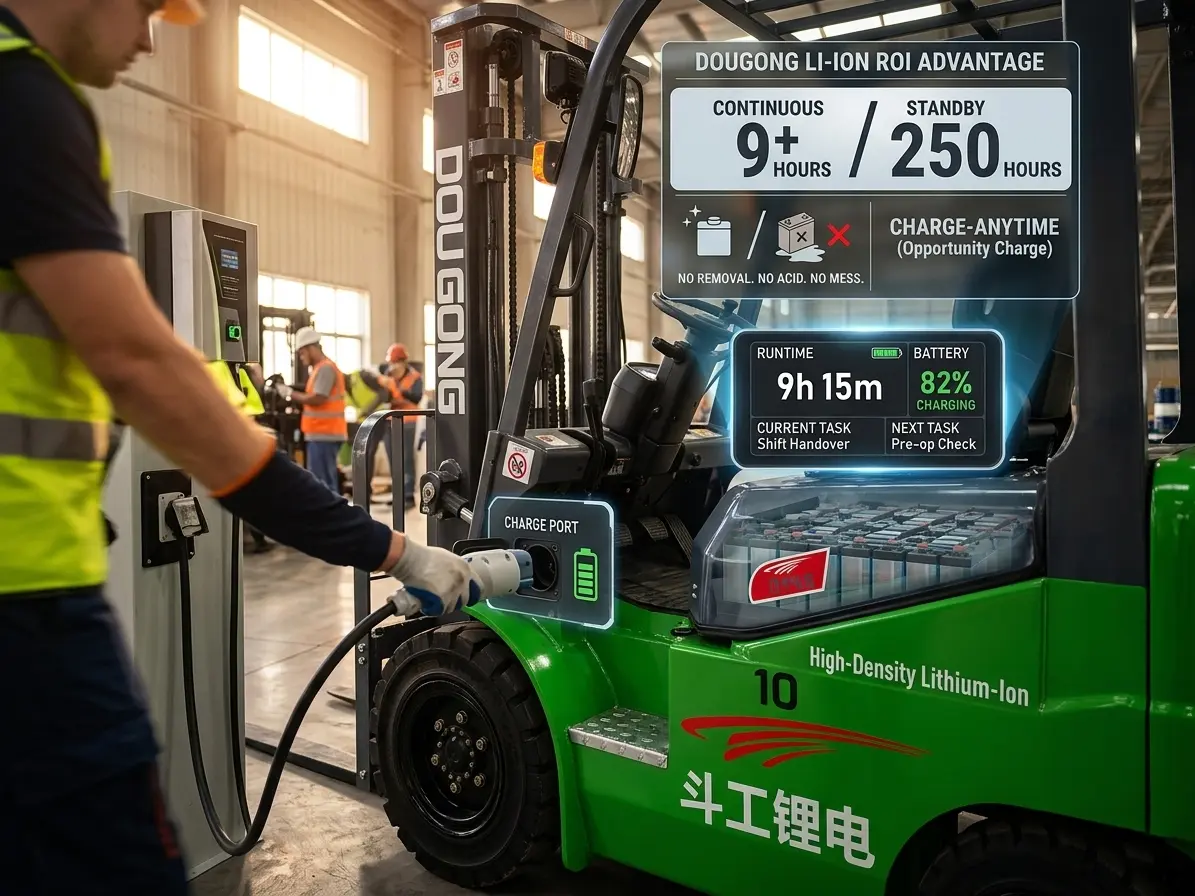
The DOGON CPD addresses this challenge head-on by discarding outdated lead-acid paradigms in favor of a state-of-the-art, high-energy-density lithium battery pack. The performance data of this system is unequivocal: a single, rapid charge guarantees more than 9 hours of continuous operation under rigorous, high-load conditions. Furthermore, the system’s advanced power management architecture ensures a full battery life capable of delivering up to 250 hours of standby time.
This is a paradigm shift for warehouse managers. Traditional electric fleets require dedicated battery rooms, complex ventilation systems, and significant labor hours dedicated to physically swapping heavy, depleted lead-acid batteries mid-shift. The DOGON CPD’s high-energy-density lithium system allows for opportunity charging. Operators can plug the machine in during scheduled breaks or shift handovers, rapidly replenishing the power reserves without ever needing to remove the battery from the chassis.
The financial contribution of this efficiency cannot be overstated. By providing over 9 hours of relentless, full-power performance, the DOGON CPD ensures that an entire shift can be completed without a single interruption for power management. The massive 250-hour standby capacity means that the machine is always ready for deployment, eliminating the parasitic drain that plagues older battery technologies during periods of inactivity. For transnational logistics providers operating 24/7, this translates to a leaner fleet requirement, zero dedicated space wasted on battery maintenance rooms, and a drastic reduction in labor costs associated with equipment servicing. The DOGON CPD does not merely operate within your workflow; it actively accelerates it, ensuring that your heavy-lift logistics remain a continuous, unbroken chain of productivity.